1. What’s the right name?
Scrooge Mr. Fezziwig The First Ghost
a) ….. spent Christmas without any friends.
b) ….. ‘s party made everybody very happy.
c) ….. wanted to help Scooge.
d) ….. was more interested in money than in other people.
e) ….. took Scrooge to his past Christmases.
f) ….. was the man Scrooge had worked for.
2. Choose the correct answers:
• In the story, Christmas time means:
a) working hard
b) being with your family
c) writing
d) eating and drinking
e) dancing
f) sleeping a lot
g) playing music
quinta-feira, 25 de novembro de 2010

terça-feira, 23 de novembro de 2010
"A Christmas Carol" by Charles Dickens (Chapter two)
The First Ghost
The first ghost appeared at one o'clock in the morning, and opened the curtains round Scrooge's bed. The ghost was an old man with long, white hair. He wore a short, brilliant wh ite dress with a bright belt and (a strange thing at Christmas!) summer flowers along the bottom. His arms and legs were bare, and in his hand he held a bunch of green holly.
‘I’m The Ghost of Christmas Past,' he said.
'Whose past?' asked Scrooge.
'Your past,' answered the ghost.
'What do you want?' asked Scrooge.
'To help you,' answered the ghost. 'Come'.
Scrooge got up from his bed. Together they flew through the wall and London disappeared. Scrooge saw they were looking at the place in the country where he had lived as a boy.
They saw many boys going home across the fields, happily shouting 'Merry Christmas' to each other. Then they saw Scrooge as a boy, reading on his own in an empty classroom.
Seeing himself as he had once been, Scrooge sat down at a desk and started to cry.
'l wish l'd given some money to that poor boy who sang Christmas songs to me yesterday,' said Scrooge.
The ghost smiled. 'Let's see another Christmas,' he said.
This time Scrooge saw the office where he had first worked. He saw Mr Fezziwig, the man he had worked for, and his wife. Young Scrooge was helping them prepare the office for a Christmas party. Soon there were many young people there. They were enjoying the dancing, the music and the food. Even he, Scrooge, was dancing and enjoying himself!
At the end of the party, Mr and Mrs Fezziwig said 'Merry Christmas' to everybody.
'l wish l'd said something to Bob Cratchit yesterday said Scrooge.
The ghost smiled again. 'Another Christmas,' he said.
Scrooge saw a beautiful woman smiling with her children in a warm home.
The door opened and the father came in, his arms full of Christmas presents. Scrooge looked at the woman; she had been his girlfriend when he was a young man! She had left him because he had been more interested in money than in her. Looking at the happy fa mily, Scrooge understood what he had lost.
'No more!' shouted Scrooge sadly. 'Leave me, ghost!'
The first ghost disappeared, leaving Scrooge back in bed where he slept deeply.
The first ghost appeared at one o'clock in the morning, and opened the curtains round Scrooge's bed. The ghost was an old man with long, white hair. He wore a short, brilliant wh
 ite dress with a bright belt and (a strange thing at Christmas!) summer flowers along the bottom. His arms and legs were bare, and in his hand he held a bunch of green holly.
‘I’m The Ghost of Christmas Past,' he said.
'Whose past?' asked Scrooge.
'Your past,' answered the ghost.
'What do you want?' asked Scrooge.
'To help you,' answered the ghost. 'Come'.
Scrooge got up from his bed. Together they flew through the wall and London disappeared. Scrooge saw they were looking at the place in the country where he had lived as a boy.
They saw many boys going home across the fields, happily shouting 'Merry Christmas' to each other. Then they saw Scrooge as a boy, reading on his own in an empty classroom.
Seeing himself as he had once been, Scrooge sat down at a desk and started to cry.
'l wish l'd given some money to that poor boy who sang Christmas songs to me yesterday,' said Scrooge.
The ghost smiled.
 'Let's see another Christmas,' he said.
This time Scrooge saw the office where he had first worked. He saw Mr Fezziwig, the man he had worked for, and his wife. Young Scrooge was helping them prepare the office for a Christmas party. Soon there were many young people there. They were enjoying the dancing, the music and the food. Even he, Scrooge, was dancing and enjoying himself!
At the end of the party, Mr and Mrs Fezziwig said 'Merry Christmas' to everybody.
'l wish l'd said something to Bob Cratchit yesterday said Scrooge.
The ghost smiled again. 'Another Christmas,' he said.
Scrooge saw a beautiful woman smiling with her children in a warm home.
The door opened and the father came in, his arms full of Christmas presents. Scrooge looked at the woman; she had been his girlfriend when he was a young man! She had left him because he had been more interested in money than in her. Looking at the happy fa
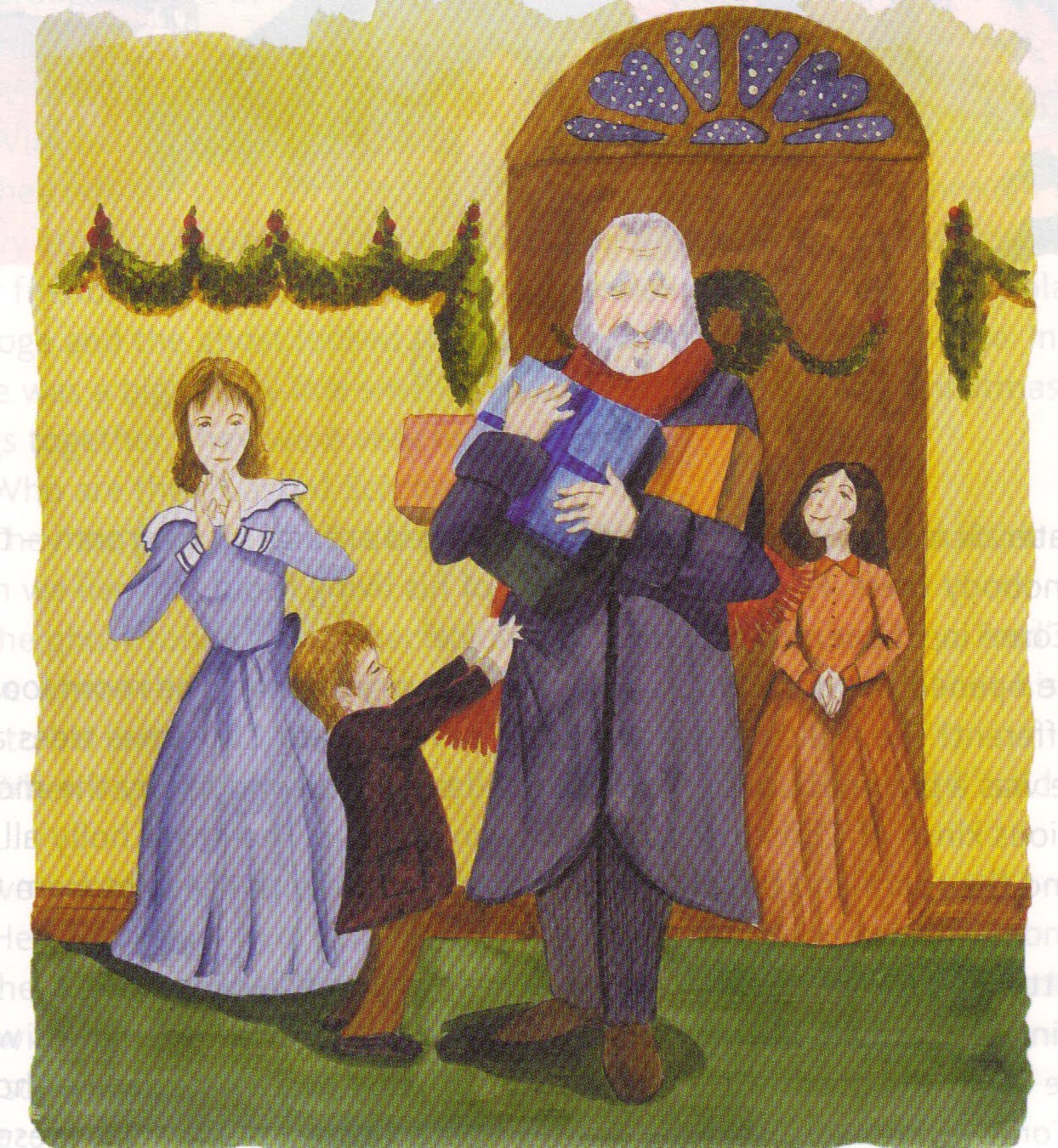 mily, Scrooge understood what he had lost.
'No more!' shouted Scrooge sadly. 'Leave me, ghost!'
The first ghost disappeared, leaving Scrooge back in bed where he slept deeply.
segunda-feira, 22 de novembro de 2010
"A Christmas Carol" de Charles Dickens - Actividades para o capítulo 1
Encontrarás na tua Biblioteca um impresso onde deverás registar as respostas destas actividades. Entrega o impresso, devidamente preenchido, na Biblioteca ou à tua professora de Inglês.
Chapter 1
1. What happened first? Put these sentences in the right order. Number them 1–10.
a) Scrooge hears the noise of a chain down below.
b) Bob Cratchit goes home.
c) Scrooge gives them nothing.
d) After Fred leaves, two men come into Scrooge's office.
e) Fred comes to visit him.
f) Scrooge doesn't give anything to the boy either.
g) The two men leave the room.
h) They ask him money for the poor.
i) He invites Scrooge to dinner.
j) Scrooge is in his office.
2. Who says what? Match the sentences with the characters.
Characters:
Scrooge
Fred
The two men
Marley
Bob Cratchit
Sentences:
a) "You don't mean it."
b) "Why are you merry?"
c) "They always need a little more."
d) "Christmas is only one day a year."
e) "I'm unhappy."
Chapter 1
1. What happened first? Put these sentences in the right order. Number them 1–10.
a) Scrooge hears the noise of a chain down below.
b) Bob Cratchit goes home.
c) Scrooge gives them nothing.
d) After Fred leaves, two men come into Scrooge's office.
e) Fred comes to visit him.
f) Scrooge doesn't give anything to the boy either.
g) The two men leave the room.
h) They ask him money for the poor.
i) He invites Scrooge to dinner.
j) Scrooge is in his office.
2. Who says what? Match the sentences with the characters.
Characters:
Scrooge
Fred
The two men
Marley
Bob Cratchit
Sentences:
a) "You don't mean it."
b) "Why are you merry?"
c) "They always need a little more."
d) "Christmas is only one day a year."
e) "I'm unhappy."
quinta-feira, 18 de novembro de 2010
Charles Dickens's London

Charles Dickens
Charles Dickens, the most popular writer of the Victorian age, was born near Portsmouth, England, in 1812 and died in Kent in 1870.
When his father was thrown into debtors’ prison, young Charles was taken out of school and forced to work in a shoe-polish factory, which may help explain the presence of so many abandoned and victimized children in his novels.
As a young man he worked as a reporter before starting his career as a fiction writer in 1833. In his novels, short stories and essays, Dickens combined hilarious comedy with a scathing criticism of the inhuman features of Victorian industrial society.
Nineteenth century London

In 1837 Queen Victoria came to the throne, aged 18. By the time of her death in 1901 London was a very different city. It had grown enormously due to industrial progress, population growth and the network of railways which had brought many parts of England within easy reach of the capital. In the Victorian era London was the centre of world trade and a powerful British empire. Better street lighting, sanitation, roads and transport gradually developed.
In Victorian London the poor were crowded into rotting houses, where they often starved or died of disease. Some of the worst-off were poor children. They were sent out from the age of four or five to make a few pennies by doing things like begging, pickpocketing and chimney sweeping.
Charles Dickens, and other campaigners, shocked the public by writing about these things, and in 1870 a new law was passed which meant that all children between the ages of 5 and 12 had to go to school.
Autoras do Mês

Ana Maria Magalhães nasceu em Lisboa no dia 14 de Abril de 1946. Licenciada em Filosofia pela Faculdade de Letras de Lisboa. É professora de Português e História no Ensino Preparatório desde 1969. Técnica de Gabinete do FAOJ durante dois anos. Professora destacada no Serviço de Ensino Básico e Secundário de Português no estrangeiro durante dois anos. Formadora de professores de História. Professora destacada no Instituto de Educação Educacional para realizar um estudo sobre os hábitos de leitura das crianças e jovens portugueses. É co-autora de várias colecções e livros didácticos.
Isabel Alçada nasceu em Lisboa no dia 29 de Maio de 1950. Licenciada em Filosofia pela Faculdade de Letras de Lisboa. Fez o Mestrado em Ciências da Educação pela Universidade de Boston. Professora destacada no Gabinete de Estudos e Planeamento do Ministério da Educação. Orientadora de História durante três anos. Técnica do Ministério da Educação para a Reforma do Ensino Secundário. Professora convidada pelo Instituto de Inovação Educacional para realizar um estudo sobre os hábitos de leitura para crianças e jovens portugueses. Foi professora do Ensino Preparatório e, actualmente, é docente na Escola Superior de Educação de Lisboa. É co-autora de várias colecções e livros didácticos. Foi empossada como ministra da Educação do XVIII Governo Constitucional, chefiado por José Sócrates.
As duas professoras conheceram-se 1976, na Escola Fernando Pessoa. Em 1982 editaram o primeiro livro: Uma Aventura na Cidade, com ilustrações de Arlindo Fagundes. Iniciaram a colecção "Uma Aventura" com o objectivo de proporcionar aos jovens livros para ler com prazer. Esta colecção constitui um êxito sem precedentes entre os jovens portugueses e dispõe já de cerca de três dezenas e meia de livros.
domingo, 14 de novembro de 2010
" A Christmas Carol" by Charles Dickens (chapter one)

Christmas Eve
It was Christmas Eve. London was very cold and foggy. Ebenezer Scrooge was working in his office. His secretary, Bob Cratchit, was writing letters in the next room, with a very small fire. Bob was very cold. Scrooge did not give Bob much wood for his fire because he did not like to spend money.
Scrooge did not like anything. He did not like the people in the streets or the people he worked with. He did not like eating good food or drinking nice drinks.
He especially hated Christmas.
Scrooge was an old man. He was very thin, with thin, white hair on his head and face. His lips were blue and his eyes were red.
He had worked in the same dark office for very many years. Once it had been the office of SCROOGE AND MARLEY, and those names were still on the door. But Jacob Marley had died seven years before and Scrooge worked on without him. Work was important. Work brought money, and Scrooge always wanted more money. So Scrooge worked hard, and made Bob Cratchit work hard, too.
Work, work, work!
'A Merry Christmas, uncle,' said Scrooge's nephew, Fred, coming into the cold, dark office.
'Bah!' replied Scrooge.'Humbug!' He really hated Christmas.
'Oh, come on, uncle,' said Fred. I'm sure you don't mean it.'
'l do,' answered Scrooge. 'Why are you merry? You're a poor man.'
'And why aren't you merry?' asked Fred. 'You're a very rich man. And it's Christmas!'
'Bah!' said Scrooge again. 'Humbug!'
'Please come to dinner with us tomorrow, uncle,' said Fred.
'Goodbye,' answered Scrooge.
'l don't want to be angry with you, uncle,' said Fred, 'só Merry Christmas.'
'Goodbye,' said Scrooge again.
Later two men came i nto Scrooge's office.
'Mr Scrooge? Mr Marley?' asked the first man, who had seen the names on the door.
'Mr Marley died seven years ago,' answered Scrooge.
'Mr Scrooge, then,' said the man. 'At Christmas, it's nice for everyone to give something to people who have nothing - no homes, no clothes, no food.'
'But there are hospitals and other places to help them,' said Scrooge.
There are,' replied the second man. 'But they always need a little more.'
'lt's not my problem,' said Scrooge. I've my work to worry about.'
The two men left.
Later a boy carne to sing Christmas songs, but Scrooge sent him away.
When it was time to close the office, Bob Cratchit was excited about the holiday next day.
'l imagine you don't want to come to work tomorrow?' said Scrooge to Bob.
'No, sir, l don't,' he answered nervously.
'And you want me to give you money for the whole week?' asked Scrooge.
'Well, Christmas is only one day a year, sir,' replied Bob.
'You'e still taking my money for nothing!' said Scrooge. 'Well, if you must, you must. But come to work earlier the morning after.'
That night when Scrooge was at home, he heard a surprise visit. He had the sound of chains coming upstairs, and then Jacob Marley walked through his door.
“Marley” said Scrooge. “You´re dead! What do you want from me?”
“I´m a ghost” said Marley. “I´ve been travelling since I died.”
“Why?” asked Scrooge.
“Because I´m unhappy”, said Marley´s ghost. “I was very bad to people when I was alive, and I want to help you not to be unhappy like me when you die.”
“How?” asked Scrooge.
“You´ll be visited by three more ghosts”, answered Marley´s ghost.
Scrooge did not like anything. He did not like the people in the streets or the people he worked with. He did not like eating good food or drinking nice drinks.
He especially hated Christmas.
Scrooge was an old man. He was very thin, with thin, white hair on his head and face. His lips were blue and his eyes were red.
He had worked in the same dark office for very many years. Once it had been the office of SCROOGE AND MARLEY, and those names were still on the door. But Jacob Marley had died seven years before and Scrooge worked on without him. Work was important. Work brought money, and Scrooge always wanted more money. So Scrooge worked hard, and made Bob Cratchit work hard, too.
Work, work, work!
'A Merry Christmas, uncle,' said Scrooge's nephew, Fred, coming into the cold, dark office.
'Bah!' replied Scrooge.'Humbug!' He really hated Christmas.
'Oh, come on, uncle,' said Fred. I'm sure you don't mean it.'
'l do,' answered Scrooge. 'Why are you merry? You're a poor man.'
'And why aren't you merry?' asked Fred. 'You're a very rich man. And it's Christmas!'
'Bah!' said Scrooge again. 'Humbug!'
'Please come to dinner with us tomorrow, uncle,' said Fred.
'Goodbye,' answered Scrooge.
'l don't want to be angry with you, uncle,' said Fred, 'só Merry Christmas.'
'Goodbye,' said Scrooge again.
Later two men came i
 nto Scrooge's office.
'Mr Scrooge? Mr Marley?' asked the first man, who had seen the names on the door.
'Mr Marley died seven years ago,' answered Scrooge.
'Mr Scrooge, then,' said the man. 'At Christmas, it's nice for everyone to give something to people who have nothing - no homes, no clothes, no food.'
'But there are hospitals and other places to help them,' said Scrooge.
There are,' replied the second man. 'But they always need a little more.'
'lt's not my problem,' said Scrooge. I've my work to worry about.'
The two men left.
Later a boy carne to sing Christmas songs, but Scrooge sent him away.
When it was time to close the office, Bob Cratchit was excited about the holiday next day.
'l imagine you don't want to come to work tomorrow?' said Scrooge to Bob.
'No, sir, l don't,' he answered nervously.
'And you want me to give you money for the whole week?' asked Scrooge.
'Well, Christmas is only one day a year, sir,' replied Bob.

'You'e still taking my money for nothing!' said Scrooge. 'Well, if you must, you must. But come to work earlier the morning after.'
That night when Scrooge was at home, he heard a surprise visit. He had the sound of chains coming upstairs, and then Jacob Marley walked through his door.
“Marley” said Scrooge. “You´re dead! What do you want from me?”
“I´m a ghost” said Marley. “I´ve been travelling since I died.”
“Why?” asked Scrooge.
“Because I´m unhappy”, said Marley´s ghost. “I was very bad to people when I was alive, and I want to help you not to be unhappy like me when you die.”
“How?” asked Scrooge.
“You´ll be visited by three more ghosts”, answered Marley´s ghost.
quinta-feira, 11 de novembro de 2010
"A Christmas Carol" de Charles Dickens
As professoras de Inglês, em articulação com as Bibliotecas Escolares, vão dinamizar uma actividade que consiste na divulgação semanal de um capítulo de uma adaptação do conto de Charles Dickens "A Christmas Carol", acompanhada sempre por uma pequena tarefa que terás de realizar.
Participa!!
Se nunca ouviste falar de Charles Dickens ou do seu conto de Natal podes ver esta breve apresentação do filme com o mesmo nome. Diverte-te!
sábado, 6 de novembro de 2010
História Colectiva Itinerante
Após "viajar" pelas escolas com 3ºciclo do nosso concelho, a história colectiva chega ao final.
Mas agora coloca-se o seguinte desafio: torna-se imperioso dar um título à mesma.
Deixa aqui a tua sugestão. Podes também deixar um comentário.
História_Colectiva_Itinerante
Mas agora coloca-se o seguinte desafio: torna-se imperioso dar um título à mesma.
Deixa aqui a tua sugestão. Podes também deixar um comentário.
História_Colectiva_Itinerante
Concurso Nacional de Leitura
O Agrupamento de Escolas de Carregal do Sal decidiu aderir ao Concurso Nacional de Leitura, uma iniciativa do Plano Nacional de Leitura em articulação com a RTP, Direcção-Geral do Livro e das Bibliotecas e Rede de Bibliotecas Escolares. Pretende-se com esta iniciativa, promover a leitura e desenvolver o gosto pela mesma entre os alunos do 3.ºCiclo e do Ensino Secundário.
Aqui fica o Regulamento:
Concurso Nacional de Leitura 2010-2011- Regulamento
Aqui fica o Regulamento:
Concurso Nacional de Leitura 2010-2011- Regulamento
quinta-feira, 4 de novembro de 2010
Anúncios disparatados
Exercício de escrita criativa dinamizado nas aulas de Oficina da Escrita:
Sinal de mais procura sinal de menos para fazerem mais ou menos a mesma conta.
Daniel Pedroso, 8ºE
Lobo mau procura 3 porquinhos para vingança.
Alexandre Fortunato, 8ºE
Sol procura a luz da sua vida.
Micaela, 8ºE
Sapatilha procura ataca para dar o nó.
Maria Inês Ferreira, 8ºE
Galo procura galinha para constituir um galinheiro.
Daniela Marques, 8ºE
Alface procura cebola para fazerem uma salada.
Maria Inês Figueiredo, 8ºE
Lobo procura cabritinhos para viagem grátis e exclusiva à sua barriga.
Mariana Serrazes, 8ºE
Toshiba com qualidades, triste e só procura Magalhães para amizade e companhia.
Sónia Oliveira, 8º F
Procuro coelha engenheira com planta de toca, para fazermos uma toca juntos.
Vítor Peixeira, 8ºF
Sinal de mais procura sinal de menos para fazerem mais ou menos a mesma conta.
Daniel Pedroso, 8ºE
Lobo mau procura 3 porquinhos para vingança.
Alexandre Fortunato, 8ºE
Sol procura a luz da sua vida.
Micaela, 8ºE
Sapatilha procura ataca para dar o nó.
Maria Inês Ferreira, 8ºE
Galo procura galinha para constituir um galinheiro.
Daniela Marques, 8ºE
Alface procura cebola para fazerem uma salada.
Maria Inês Figueiredo, 8ºE
Lobo procura cabritinhos para viagem grátis e exclusiva à sua barriga.
Mariana Serrazes, 8ºE
Toshiba com qualidades, triste e só procura Magalhães para amizade e companhia.
Sónia Oliveira, 8º F
Procuro coelha engenheira com planta de toca, para fazermos uma toca juntos.
Vítor Peixeira, 8ºF
quinta-feira, 28 de outubro de 2010


segunda-feira, 25 de outubro de 2010
Dia da Biblioteca Escolar - 25 de Outubro
 "Os alunos tornam-se melhores leitores quando têm acesso a uma Biblioteca Escolar para ler."
in IASL
Mais um ano lectivo na nossa Escola e na nossa Biblioteca! Neste dia, 25 de Outubro, é comemorado o "Dia da Biblioteca Escolar" e, escolas por todo o mundo celebram-no com actividades especiais para ressaltar o papel da Biblioteca Escolar na educação, na sociedade e na cultura.
quarta-feira, 20 de outubro de 2010
Autor do Mês - Mário Vargas Llosa

Mário Vargas, 74 anos, galardoado com o Prémio Nobel da Literatura 2010, é um dos mais premiados autores da América Latina pelo seu trabalho como romancista, ensaísta e dramaturgo.
"Quando vi publicado o meu primeiro livro, em 1958. Eu tinha 22 anos e esse livro de contos tinha ganho um prémio em Espanha, onde era estudante. Recordo que foi uma grande felicidade vê-lo editado, porque era a confirmação do sonho de ser escritor.”
In Jornal de Letras, 2003
"Todos os anos ele sonhava com isto. Euforia na Feira do Livro de Frankfurt Abraços, telefones que não paravam de tocar e muitos sorrisos. Foi o êxtase no stand da Santillana na Feira do Livro de Frankfurt. Ao final da manhã, quando se soube, ontem, que o Nobel da Literatura fora para Mario Vargas Llosa, os jornalistas correram para onde se encontrava a sua editora, a colombiana Pilar Reyes, directora da Alfaguara Espanha. Foi com ela que nas últimas semanas o escritor esteve a preparar a edição do seu próximo romance El Sueño del Celta."
terça-feira, 19 de outubro de 2010
Bibliopaper na nossa Biblioteca

No próximo dia 25 de Outubro, Dia da Biblioteca Escolar, vai realizar-se um Bibliopaper na nossa Biblioteca. Para participar basta formar uma equipa de três elementos e fazer a inscrição na BE até dia 22, Sexta-feira.
Subscrever:
Mensagens (Atom)